
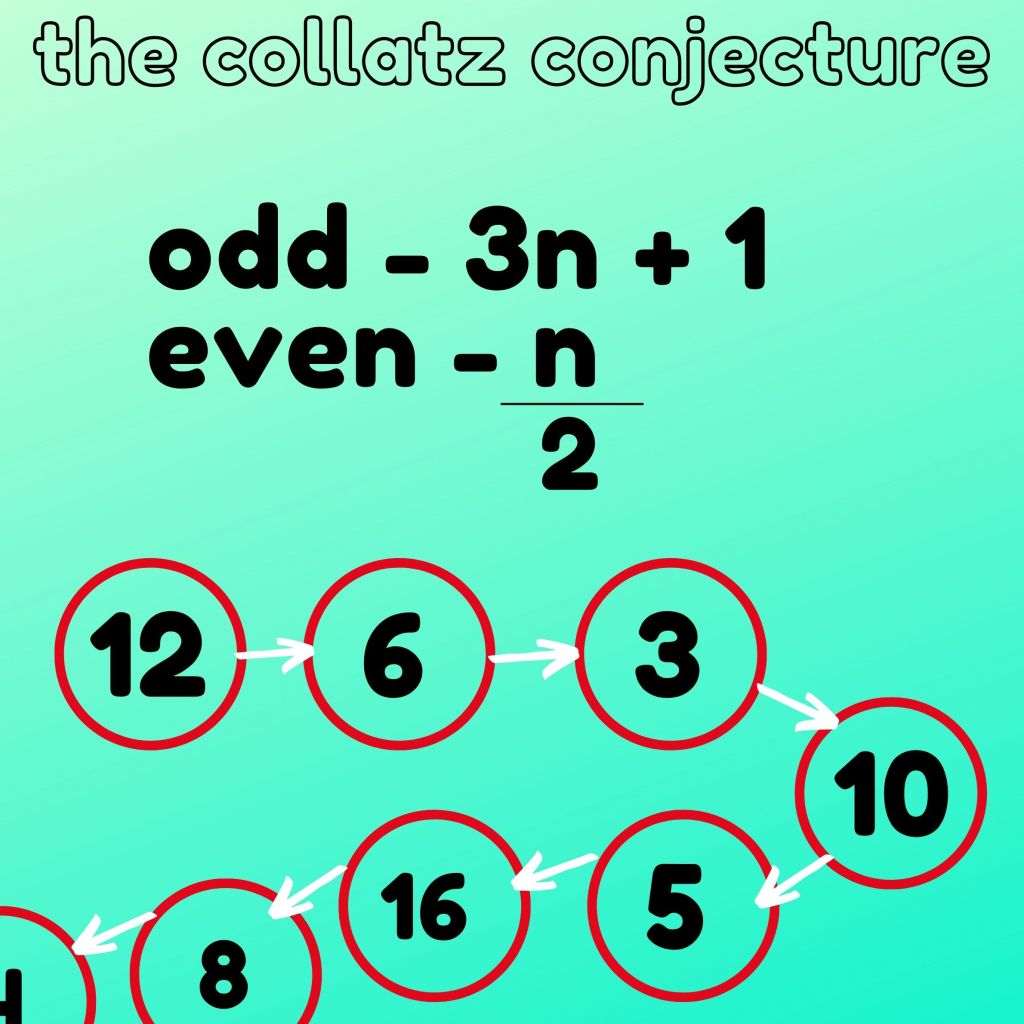
Lesson Plan:
This problem was first raised by Lothar Collatz in 1937, and involves a simple iterative process. write down a positive whole number. If it is even, halve it. If it is odd, multiply it by three and add on one.
Very easy to follow instructions means most students can give this a go, but the fun is just beginning, as when they start to make the assumption that the number will end at one (and it always should for any number that they can fathomably calculate) you can declare that this is in fact NOT proven and no-one has yet managed to prove it. In fact it is one of the top 10 maths problems yet to be solved and should your students find a number that doesn’t get to one – they will have proven it to be false and would become minor celebrities in the academic world!
My Experience
When I have run this problem, my most able students quickly understand that the calculations lead to one. They then think that is that -until I add some competition into it and ask them to find the number less than 100 with the longest steps taken. It is 97, but it takes over 110 steps before it gets to zero! Most of my students started to give up after about 50 steps.
So we suggested a way of making it easier – inspired by the Numberphile video below. We mapped out the number 12, and then realised that it showed us all the steps for starting number of 2,4,8,5,10 and others. So we don’t need to check these numbers. So then we try another low number like 23. After 10 steps, we hit 10 again, and so we know how many more steps until 1. from here we can split the numbers up easily across the classroom. (if you are smart about it – give the even numbers to those who work a little slower) and soon you build up a beautiful network of numbers that all lead to one.
From here we talked about even numbers and powers of two, and then prime numbers and how they seem to have long chains. We then talked about how hard it is to work some of these out, even a number as low as 31.
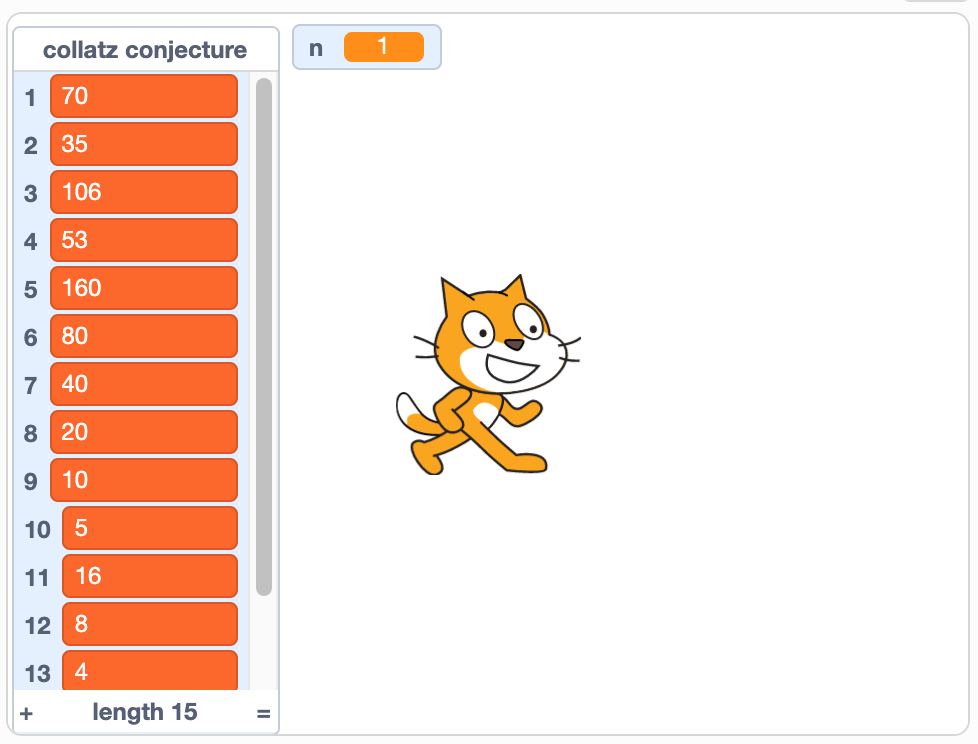
Finally, before writing down our summary of the conjecture, I introduce them to the Scratch project shown below. This great little tool works it out for them, so they can just enjoy guessing numbers and checking they go down to 1. If you have time, you can have fun trying to find the longest chain of four or five digit numbers.
 Maths Beyond the Curriculum