
Lesson Plan (coming soon)
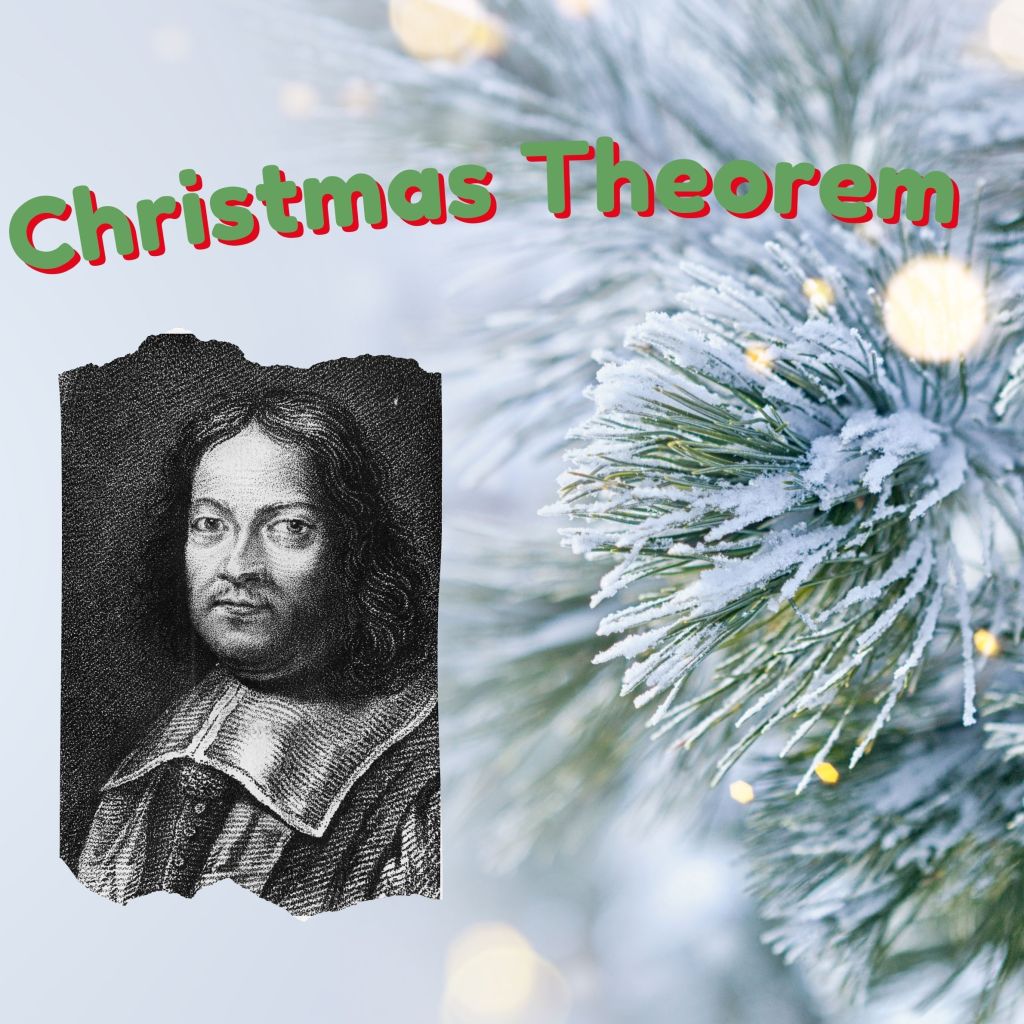
Pierre de Fermat is one of the most famous mathematicians of all, influencing great minds like Isaac Newton and Blaise Pascal, but he had a particular quirk about his mathematics. Fermat is that one student who always gets answers correct but never writes down their working out. In fact he is the master of it, because on numerous occasions he wrote down theorems with nothing to back it up. Like telling your friend you can run 100m in 11 seconds… but not today.. as your knee is a bit sore.
The most famous of his theorems of course is Fermat’s last theorem, which was left unsolved and unproven as a side note in a margin of his books, and this took 358 years to be finally proven for good. This theorem appears in various books and even is referenced on The Simpsons.
But this isn’t about that theorem. It is another one which is formally called ‘the sum of two squares theorem‘ but thankfully, since Fermat wrote it on a letter to fellow mathematician Mersenne (yes the one who has some prime numbers named after him) which was dated 25th December, it is also called the Christmas theorem. And once again, he claimed he had proof for this idea, but didn’t actually show anyone what they were!
This lesson we can begin in two ways – addressing the work of Fermat head on – or by playing a game and then building a few ideas from there. It depends on your class really. If you have a good set of students who like solving puzzles and like open ended challenges, then the game is a good start. Otherwise hook them with Fermat’s eccentric ideas of how he claimed these great theorems.
What is the theorem then? Well simply that some odd prime numbers can be written as the sum of two squares, such as 13 can be written as 2 squared + 3 squared (4 + 9), but more importantly, that there is a pattern between the odd primes that can work and the ones that can’t.
The odd primes which can be shown as the sum of two squares are called Pythagorean primes, which is pretty cool. Also, Fermat was held in such high esteem that some of the greatest mathematicians since had ago at proving it for themselves in different ways, including Euler, Gauss and Lagrange. The proof is hard to follow – but there is a great video which explains it in more simple terms.
What is wonderful – and a great ending to the lesson – is to ask if a huge prime number, say 3,628,273,133, can be written as a sum of two squares or not. (We don’t need to know what those squares could be for now). This is pretty easy to check – once you spot the pattern. All primes 1 bigger than a multiple of 4 ( 1 modulo 4) can be written that way. For example 17, 41 and 53 all work as they are all 1 more than a multiple of 4 (16,40 and 52)
My Experience
IDEA 1 – So class, let’s play a game using square numbers and primes. The number 13 can be written as 3 squared plus 2 squared. The first person to do the same for these four numbers wins a prize:
5, 17, 41, 31
The important thing is – don’t tell me you’ve finished till you have all four answers – so that no-one cheats by only working out one of them and still winning because they heard the other answers.
After a while – students will start saying that 31 is impossible – to which you reply simply “is it?” “Are you 100% sure?” This is helping them learn how to prove – can they prove it? students will turn to decimals – shut this down early if needed, of course decimals will never work to give an integer answer.
IDEA 2 -Just go straight in with the theorem – that odd primes can sometimes be written as the sum of two squares. Then see how many of the first 100 primes we can work out. I often put the list up and then every time someone finds an answer, they can tell me and i’ll write it in and put their name by it.
From there, depending on ability, I’ll discuss about spotting patterns and maybe hint about writing the four times table out. This can then lead to a conjecture (not proof as we won’t be able to prove something like this at this age range) about how to tell if a prime number does have a sum of two squares.
The final message to the kids is this – even though we have found out which numbers work and which don’t. No-one has ever come up with a way of quickly finding the two numbers that would be the squares. This is why we use prime numbers for encryption in computing, because it is just too diffficult to identify large numbered primes.
 Maths Beyond the Curriculum