
Lesson Plan
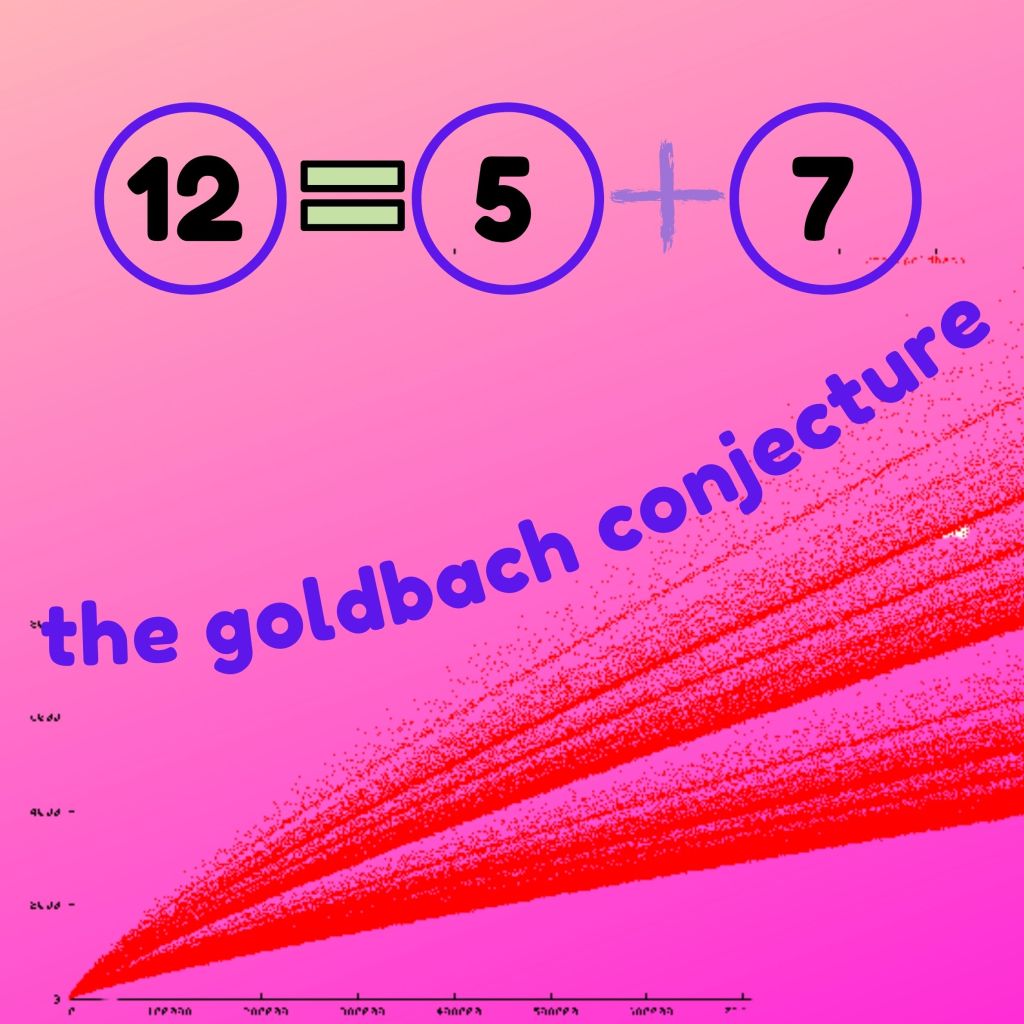
The Goldbach Conjecture is another of those simple statements that mathematicians believe to be true, but cannot be certain. This is why it is a conjecture, not a theorem (like the Collatz Conjecture). The premise is simple: Christian Goldbach wrote to world renowned mathematician and philosopher Leonard Euler and remarked, in a round about way, that all positive even numbers (greater than 2) can be written as the sum of two prime numbers. So for example, the number 16 can be created by adding 3 and 13, which are both prime. It seems rather innocuous, but remarkably mathematicians can’t prove it for EVERY positive even number.
If they could prove it, it would open up proof for a number of other conjectures, such as that every number can be written as a sum of three primes (which makes sense, as once you have all the even numbers you can add on a 3 to make every number).
This again is a lesson on proof, mostly, and the idea that proof by exhaustion (where every possibility is tested) is impossible in cases like this. Every number up to 4 x 10¹⁸ has been tested and works, but there is still some way to go before there is a definite proof. One of the big reasons why the proof is so difficult, and what makes it a great investigatory lesson, is that there are often multiple ways of adding two primes to make an even number. 40 for example, can be 37 + 3, or 17 + 23. This is in contrast to prime factors, which there is proof to show that each number has a unique product of prime factors.
My Experience
So I started with a quick check on prime numbers and adding, that nicely leads in to the Goldbach conjecture (see slides).
We start by choosing any even number less than 50 and seeing if we can find two primes that add to make it. Usually one student thinks they have found one, but we can discredit it quickly. So we then wonder – do all even numbers work, or do all numbers work?
Then I share William Goldbach’s conjecture and we work through the challenges, just a simple addition problem really, with good practice of understanding prime numbers. We extend by looking at various different combinations leading to the same number. This opens up a challenge to see who can find the number below 50/100 that has the most prime pair sums.
This lesson is super simple in terms of the maths involved, a great way to show that even the most advanced mathematics can be done by anyone!
 Maths Beyond the Curriculum