
Lesson Plan (coming soon)
A great way to learn about probability is to look at certain aspects of how computer games offer players items and rewards, and Minecraft is a great example, as you can easil access the code behind the game to check the probabilities.
In fact, mathematics was used in 2020/2021 because of a popular Minecraft Youtuber by the name of Dream, who has 40 million subscribers and will almost certainly be known by students over the age of 8 (though he isn’t family friendly – so don’t suggest to watch it!).
One of Dream’s videos is about speedrunning – which is trying to complete the game as fast as possible. I won’t go into all the details here – you can find more on this from the video a bit further down by the excellent Matt Parker. Essentially, Dream was accused of cheating in his speedrun, because certain events in the game all seemed to go in his favour and that allowed him to complete the game much more efficiently. It is to do with odds of important items being ‘dropped’ by certain characters and enemies, in particular items that usually drop with a rate of 5%, and he was achieving about a 16% success rate.
The speculation of cheating led to Dream himself asking an astrophysicist to confirm that he had just got lucky, and a written paper was completed showing proof that the sequence of events that happened were completely plausible. But the controversy didn’t stop there because various mathematicians then critiqued the astrophysicist’s work – and spotted numerous errors. It is now widely considered that this speedrun is not legitimate as the odds were astronomically high. In other words it is reasonable to suggest that Dream had changed the settings in Minecraft to give him a better chance of completing the game.
Matt Parker puts it best when he explains that if every human on the planet played Minecraft every second for the next 100 years, still no one would have the luck that Dream had in his video. It is that unlikely!!
We can’t go into the irregularities against the binomial distribution at this age range – though it is fascinating if you teach A-Level students. What we can do is learn how to use what we know about probability to help us spot when we think someone may be lying about Minecraft and perhaps make sense of other unlikely scenarios in the real world.
My Experience
Usually I introduce this with KS2 or early in KS3, before they have even learnt much about probability – we discuss the story above – with a real emphasis on how Minecraft was the focus of several mathematical papers written at University level and those authors are then talked about by a huge online community. Talk about rockstar mathematics!!
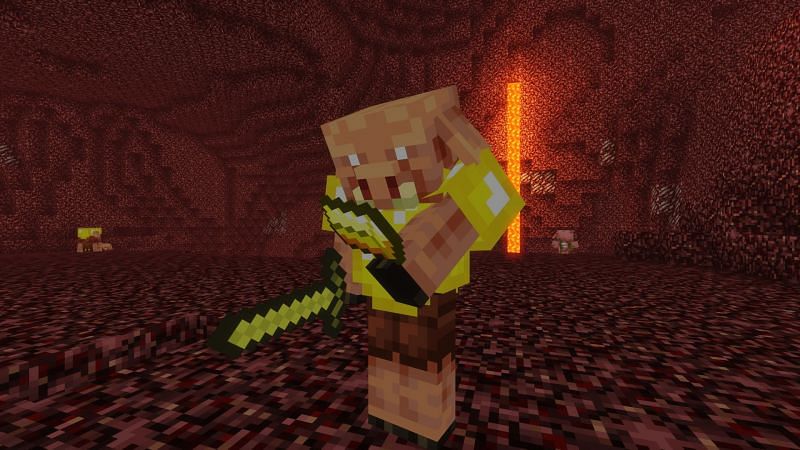
Now – if you have Minecraft as a teaching resource – you could run a few data collecting activities. This is more advanced and so I expect this to only make sense if you are familiar with Minecraft. You could ask your students to open a creative world and spawn a piglin – and then barter with him (give him gold ingots) and record what he throws back to you in a table, and do it as many times as possible. Or set the class a challenege – have students build some water, and then spawn two axolotls. Then, by using tropical fish, you can breed a baby axolotl. Incredibly there is a 1 in 1200 chance that the baby will be blue. Most of the time it will match the colour of one of the parents. The chances (1 in 1200) reflect how rare blue axolotl/salamanders are in real life as they are endangered species.
Otherwise – work through the table in the slides, explaining how probability works and what each value represents. Then talk about expected outcomes. What would you expect if you traded with a piglin 10 times? How many blaze rods would you expect if you killed 20 blazes? The key for me is to convince my students that probablity results can be varied – but there is generally a limit to how unlikely an outcome is.
 Maths Beyond the Curriculum