

This world is aimed as an introduction to sequences, or as part of a unit for younger students. The activity is fairly easy up until the last question, which does involve a little bit more thinking. The questions are based on some simple patterns and sequences and lead up to a final challenge where they can free build their own.
Link to the .mcworld file – Google Drive
Quick Guide:
- If you can run it with a teacher to student ratio of 1:12 or less, then you can have the teacher host the world and students join that world.
- Another option is for students to import this world and play independently. More information on how to do that is available here
- The students log into Minecraft Education Edition and either import the world and play independently, or join world using your code.
- Students look at the blocks and work out what comes next, then they speak the NPC characters in the game and click on the correct answers
- The final area asks them to build their own sequence or pattern. This is the only area that they can place blocks
- Review as a group the created sequences or patterns. Decide what type it is and what blocks would go next
The Lesson
This lesson was created as part of my series of lessons on sequences and patterns taught as an enrichment over a few weeks. Sequences are usually covered from age 10+, but spotting patterns and rules can be done from any age where they have some comfortable knowledge of times tables, so confident mathematicians from about 6/7+
After having some familiarity with how sequences grow depending on a rule, whereas patterns are something that repeat, we moved onto the lesson on Minecraft Education Edition.
Having a small class of 10 students, I was able to manage this as a host, loading up the world and sharing the code.

The students join the world and are restricted in where they can go so it is ideal for younger students or a starting world. The instruction is to talk to the characters who will ask questions about the blocks in that area. For example, in the first section, a pattern of red, yellow, red, yellow, red, yellow, and the character asks, what colour will come next.
At any point, if they get a question wrong, they are sent back to the start. This encourages them to take their time and not guess as it can be frustrating to do it all over again!
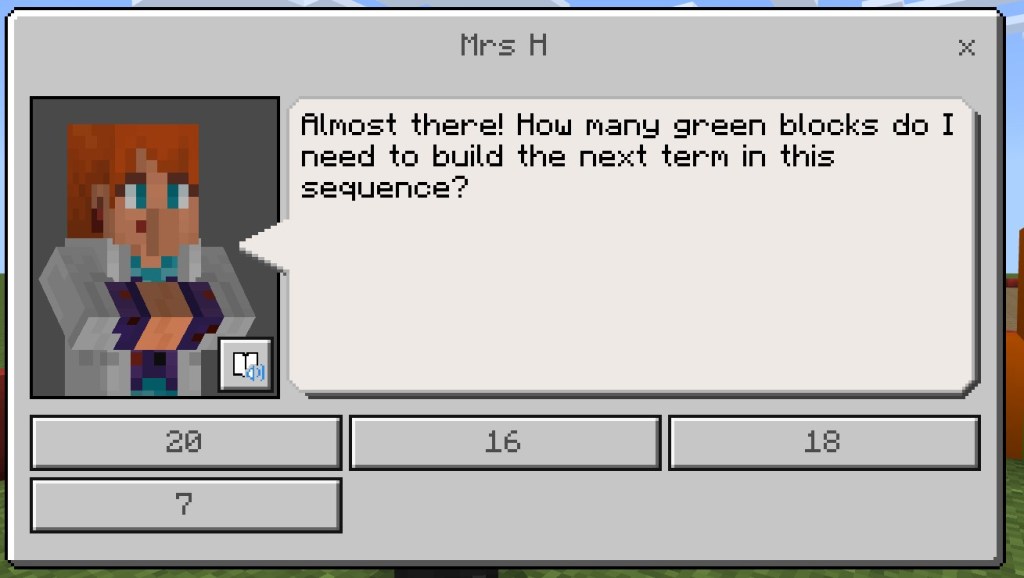
Most of the questions revolve around easy to identify arithmetic sequences, but the final question before the free build involves a little more logic and oftentimes I’ve had to help out a students on that problem.
Moving into the free build, they will be given some colourful blocks by the character (or they can access them in their inventory, if they want to) and asked to create a sequence or a pattern. From previous experience it is usually a pattern, I do try and challenge them to create a sequence with a rule, particularly the most confident.
We finish by reviewing their builds, and as mentioned I have small numbers, so we went round the structures together, and we even challenged ourselves to complete the next part of the pattern or sequence and the creator would tell us if that was correct or not.
 Maths Beyond the Curriculum